Landlord Fire Safety Checklist: Every Duty in One Place
Updated 12 June 2026|9 min read
Landlord fire safety duties come from several overlapping sources: the Smoke and Carbon Monoxide Alarm (Amendment) Regulations 2022, the Regulatory Reform (Fire Safety) Order 2005 as amended by the Fire Safety Act 2021, the Fire Safety (England) Regulations 2022, plus electrical and gas safety requirements. This checklist turns them into one practical list you can walk a property with, covering alarms, fire doors, escape routes, paperwork and the prices for putting gaps right.
Alarms: the non-negotiable baseline
Start every fire safety walk-round at the alarms, because they are the cheapest item on the list and the one with the clearest legal duty behind it.
The Smoke and Carbon Monoxide Alarm (Amendment) Regulations 2022 require at least one smoke alarm on every storey with living accommodation and a carbon monoxide alarm in any room containing a fixed combustion appliance such as a boiler, gas fire or wood burner, with gas cookers excluded. Alarms must be demonstrated working at the start of each tenancy, and once a tenant reports a fault, repairing or replacing the alarm is the landlord's job, promptly.
In an HMO, your licence conditions raise the bar, typically to interlinked Grade D1 mains-powered alarms with a heat alarm in the kitchen and coverage of escape routes and high-risk rooms.
Checklist actions: press the test button on every alarm and record the result; check manufacture dates and replace any unit over ten years old; confirm CO alarms exist in every room with a combustion appliance; and in an HMO, confirm the installation matches the grade and coverage named in your licence conditions, not just the national minimum.
Fire doors and means of escape
The escape route is the spine of fire safety in any rental: in a fire at night, everything depends on tenants being able to walk from their bed to the street.
Walk the route first. It must be clear of stored items, bikes, prams and the accumulated belongings that colonise hallways in shared houses; combustible storage under the staircase is a classic finding. The final exit must open without a key from the inside, which usually means a thumb-turn lock, £60–£120 fitted.
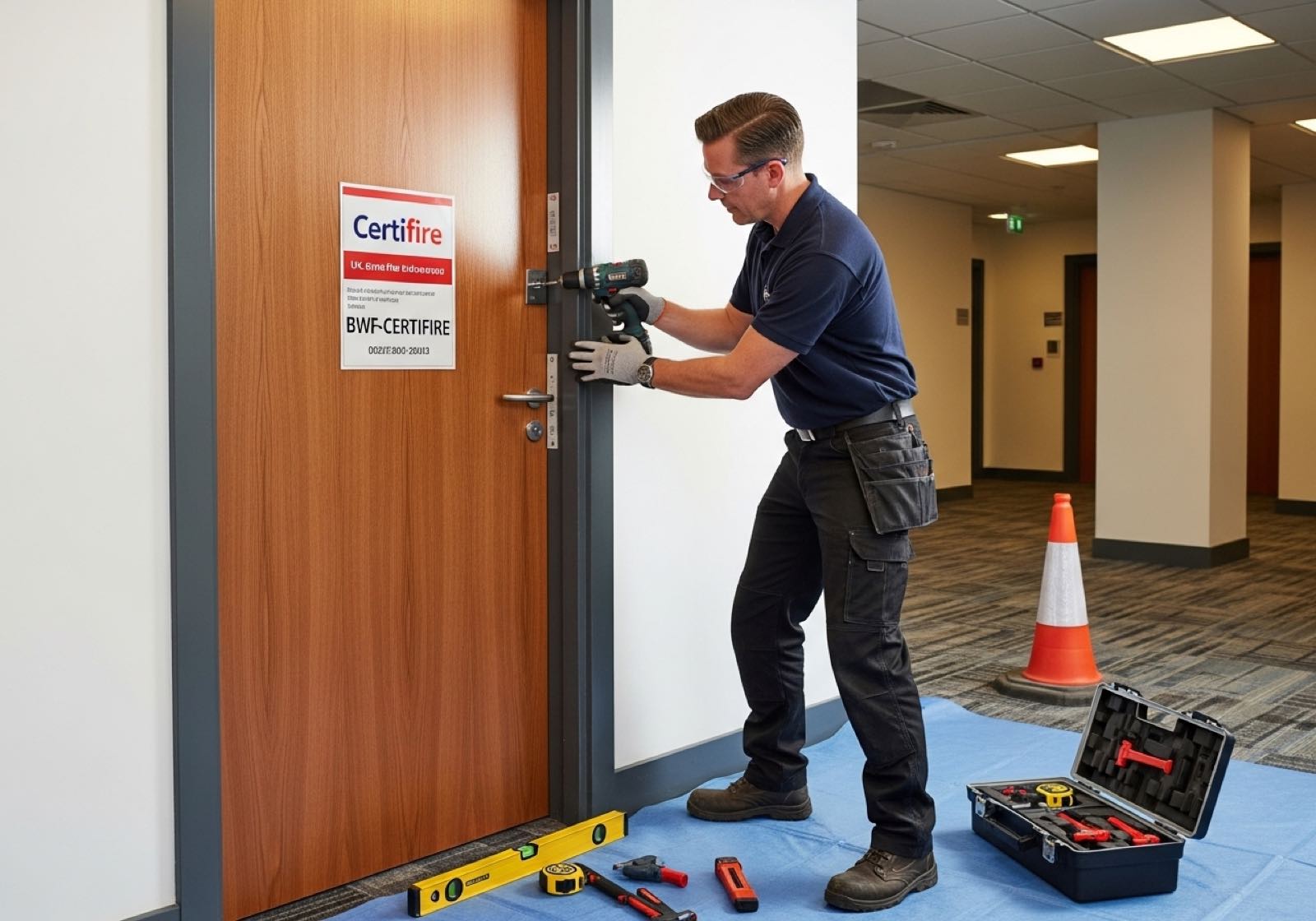
Then the doors. In HMOs, doors opening onto the escape route are expected to be FD30 fire doors with intumescent strips, cold smoke seals and self-closers. Check that closers actually shut each door into its frame, that seals are intact and unpainted, and that gaps run around 3mm and never beyond 4mm at the head and sides.
The Fire Safety Act 2021 put flat entrance doors and the building's structure and external walls firmly within the scope of the fire safety order for buildings with two or more dwellings, so if you let flats, the front door of each flat is part of the regime, not just the communal corridors.
Furniture, electrics and gas
Three further duties round out the fabric-and-contents side of the checklist, and each comes with a document an inspector will ask to see.
Furniture you supply in a furnished let must meet the fire resistance requirements for upholstered furnishings, evidenced by the permanent labels sewn into compliant items. Check labels survive on sofas, mattresses and upholstered beds, and dispose of any inherited furniture without them; secondhand sofas of unknown origin are not worth the risk.
Electrical safety requires an electrical installation condition report (EICR) at least every five years by a qualified person, with a copy to tenants within 28 days and to the council on request, and remedial work coded as necessary completed within 28 days. Any appliances you supply should be visually checked and ideally PAT tested between tenancies.
Gas safety requires an annual check of every gas appliance and flue by a Gas Safe registered engineer, with the record given to existing tenants within 28 days and to new tenants before they move in.
None of these is novel, but they expire quietly: the checklist habit is simply confirming all three documents are current every time you think about the property.
Fire risk assessments: who must do one
The Regulatory Reform (Fire Safety) Order 2005 makes a responsible person, in practice the landlord or managing agent, responsible for assessing and managing fire risk in the non-domestic parts of residential premises, which means the common parts of HMOs and blocks of flats: shared hallways, staircases, communal kitchens and lounges.
If you let an HMO or a flat in a building with shared areas, a fire risk assessment is not optional. The Fire Safety Act 2021 clarified that the assessment must also cover the building's structure, external walls and flat entrance doors, closing the argument that those elements fell outside the order.
The Fire Safety (England) Regulations 2022 then added concrete duties in multi-occupied residential buildings, scaled by height. In buildings over 11 metres, that includes quarterly checks of fire doors in communal areas and annual checks of flat entrance doors, with records kept.
The assessment must now be recorded in writing in full, whoever carries it out. For a small HMO a competent landlord can self-assess using published guidance; for larger or more complex buildings, commission a professional assessor, typically £250–£600 for an HMO, and act on the action plan rather than filing it.
The walk-round checklist
Here is the whole regime as a single table you can print and walk a property with. Frequency matters as much as the items themselves, because nearly every fire safety failure we see started life as a completed task that nobody repeated.
Use it at tenancy changeover as a minimum, and quarterly in HMOs, where wear and tear on doors and the temptation to wedge them open both run higher. Tie the monthly and annual items, alarm checks, emergency lighting tests and certificate renewals, to calendar reminders rather than memory.
Where the table mentions the over-11-metre door check duties, they apply to multi-occupied residential buildings of that height under the Fire Safety (England) Regulations 2022; in smaller HMOs, checking the doors on the same rhythm is not legally mandated but is cheap insurance and exactly what a licensing officer hopes to find in your records.
Check
Frequency
Smoke alarm on every storey, tested and recorded
Start of tenancy, plus tenant reports
CO alarm in rooms with fixed combustion appliances
Start of tenancy
Fire doors: gaps, seals, closers working
Quarterly communal and annual flat entrance (buildings over 11m); quarterly good practice in HMOs
Escape route clear, thumb-turn on final exit
Every visit
Emergency lighting function test and logbook
Monthly, plus annual discharge test
EICR by qualified electrician
Every 5 years
Gas safety record by Gas Safe engineer
Annually
Fire risk assessment review
Annually, and after any material change
Furniture fire labels present on supplied items
Tenancy changeover
What to document and keep
Fire safety compliance is half physical works and half evidence, and after an incident the evidence is what stands between you and liability.
Keep one file per property, digital or paper, containing: the current fire risk assessment and its action plan with completion dates; alarm installation certificates and the tested-at-tenancy-start records; the EICR and gas safety record; emergency lighting certificates and the test logbook; fire door installation or upgrade invoices and photographs of certification labels; and copies of everything you have given tenants, with dates.
Photographs are underrated. A dated photo of a fire door label, a clear escape route or a fitted CO alarm takes seconds and answers questions years later that no invoice can.
Licensing officers ask for this file at inspection, insurers ask for it after a claim, and tribunals ask for it when a tenant alleges neglect. The landlords who sail through all three are not the ones who did more works; they are the ones who can prove the works they did. Set the file up once, and every renewal becomes a fifteen-minute update instead of an archaeology project.
Fixing the gaps: what remedial works cost
Most properties fail a checklist like this in small, fixable ways, and the costs are modest when the works are planned rather than enforced.
At 2026 London prices: Grade D1 interlinked alarms run £80–£150 per unit installed; CO alarms £50–£90 fitted; FD30 fire doors £400–£900 each as certified doorsets or £150–£350 to upgrade sound existing doors; thumb-turn locks £60–£120; emergency lighting £250–£450 per fitting or £800–£2,000 for a small HMO system; and a professional fire risk assessment £250–£600.
A typical unmodernised HMO needs £3,000–£8,000 to clear every item, and a single-family let usually far less, often just alarms and paperwork.
The efficient route is one contractor and one visit covering doors, alarms, lighting and the joinery and decoration that follow them, with certificates issued as a single pack. That is the shape of the compliance work we do across London rentals week in, week out, and it exists because coordinating four separate trades around tenants is the part landlords reliably underestimate. Walk the checklist, price the gaps, fix them once, and the annual routine after that is genuinely light.
Frequently Asked Questions
Do I need a fire risk assessment for a buy-to-let?
For a single-family house let with no shared areas, no formal fire risk assessment is required. For any HMO, or any flat in a building with communal areas, the Regulatory Reform (Fire Safety) Order 2005 requires one covering the common parts, and since the Fire Safety Act 2021 it must also consider the structure, external walls and flat entrance doors. It must be recorded in writing.
How often do fire doors need checking in a rented building?
In multi-occupied residential buildings over 11 metres, the Fire Safety (England) Regulations 2022 require quarterly checks of communal fire doors and annual checks of flat entrance doors, with records kept. In ordinary HMOs, quarterly checks of gaps, seals and closers are good practice that licensing officers expect to see evidenced.
How often does a rental need an EICR and gas safety check?
An EICR at least every five years by a qualified electrician, with remedial work completed within 28 days where coded, and an annual gas safety check of all appliances and flues by a Gas Safe registered engineer. Both documents must be given to tenants and produced for the council on request.
What smoke alarms does the law require in rented property?
Under the Smoke and Carbon Monoxide Alarm (Amendment) Regulations 2022: at least one smoke alarm per storey with living accommodation, a CO alarm in every room with a fixed combustion appliance (gas cookers excluded), all working at tenancy start and repaired promptly when reported. HMO licences typically require interlinked Grade D1 systems on top.
How much does it cost to make a rental fire-safe?
A single-family let usually needs only alarms and documents, often under £500. An unmodernised HMO typically needs £3,000–£8,000 at 2026 prices, covering FD30 doors at £400–£900 each, interlinked alarms at £80–£150 per unit, emergency lighting from £800 and a professional fire risk assessment at £250–£600.