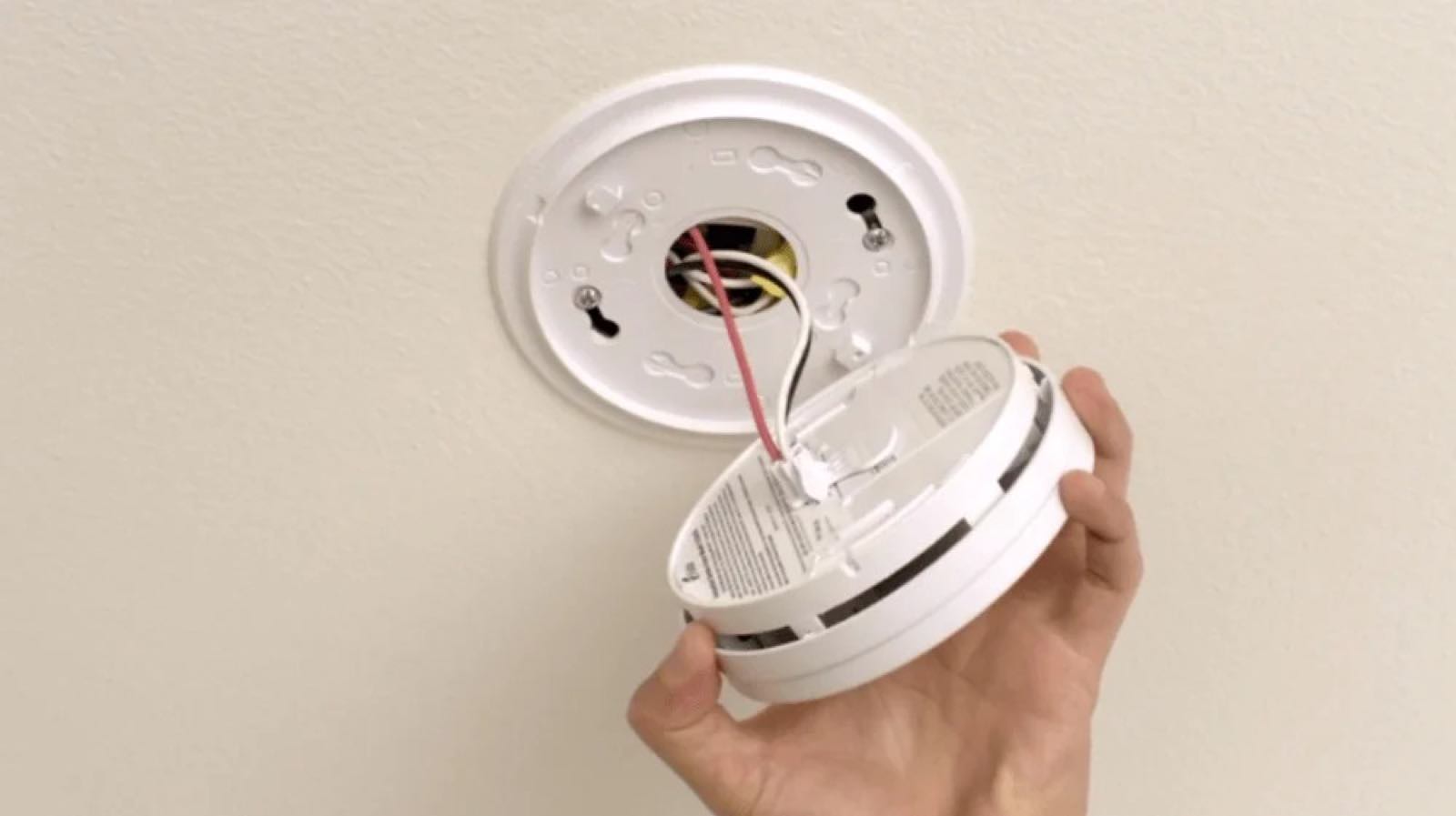
Smoke Alarm Regulations for Rented Property: 2026 Guide
Updated 12 June 2026|8 min read
Every rented home in England must have a smoke alarm on each storey with living accommodation and a carbon monoxide alarm in any room with a fixed combustion appliance, under the Smoke and Carbon Monoxide Alarm (Amendment) Regulations 2022. Interlinking is not spelled out in those regulations, but BS 5839-6 and HMO licensing conditions effectively require it: most London boroughs expect interlinked Grade D1 systems in HMOs. Budget £80–£150 per alarm installed in 2026.
What the 2022 regulations require in every rented property
The Smoke and Carbon Monoxide Alarm (Amendment) Regulations 2022 set the floor for every private and social rented home in England, and the requirements are short enough to memorise.
First, at least one smoke alarm on every storey that contains living accommodation, which includes a converted loft bedroom and a basement kitchen. Second, a carbon monoxide alarm in any room used as living accommodation that contains a fixed combustion appliance: a gas boiler, a gas fire, a wood burner or an oil appliance. Gas cookers are the one exclusion.
Third, the alarms must be shown to be working at the start of each new tenancy, and once a tenant reports a fault, the landlord must repair or replace the alarm as soon as reasonably practicable. That repair duty sits firmly with the landlord; you cannot push battery replacement in a failed alarm onto the tenant and call it their problem.
Enforcement runs through the local authority, which can serve a remedial notice and fine a non-compliant landlord up to £5,000 per breach. For the cost of a few alarms, it is the cheapest compliance on the entire landlord checklist.
Do smoke alarms need to be interlinked?
The 2022 regulations themselves do not use the word interlinked, and for a straightforward single-family let, standalone alarms on each storey satisfy the letter of the law. But two forces push landlords towards interlinked systems, and ignoring them is a false economy.
The first is BS 5839-6, the British Standard for fire detection in dwellings. It is the benchmark that courts, licensing officers and fire risk assessors measure installations against, and for new and materially altered systems it expects alarms to be interlinked, so that a fire detected anywhere sounds everywhere.
The second is HMO licensing. Licence conditions in London boroughs almost universally require interlinked alarms, because the physics of a shared house demands it: a smoke alarm sounding in a basement kitchen will not wake a tenant asleep behind a closed fire door two storeys up. Interlinking means every alarm in the house sounds together, which is the entire point of early warning in a building where strangers sleep behind separate doors.
The practical rule: single-family let, standalone alarms are legal but interlinked is better; any HMO, treat interlinked as mandatory because your licence will say exactly that.
BS 5839-6 grades: what Grade D1 means
BS 5839-6 grades describe how an alarm system is powered, and the grade determines whether a licensing officer accepts it.
Grade D1 is the standard expectation for rented property: mains-powered alarms with a sealed, tamper-proof standby battery that lasts the life of the alarm, typically ten years. Mains power means the alarm is always fed; the sealed battery means it survives a power cut and tenants cannot harvest the battery for the TV remote, which is precisely why licensing officers favour it.
Grade D2 is the same arrangement with replaceable backup batteries, acceptable in some situations but weaker for exactly the reason above. Grade F covers battery-only alarms, and these are generally not accepted in licensed HMOs regardless of how long the battery claims to last.
At the top sits Grade A: a panel-based system with detectors, sounders and manual call points, professionally designed and zoned. Larger and higher-risk HMOs, particularly bedsit-style properties of three storeys and more, are often required to have a Grade A system in the communal areas working alongside Grade D alarms in the lettings.
For the typical London shared house, Grade D1 interlinked alarms are the answer, and anything battery-only is budget spent on the wrong product.
LD1, LD2 and LD3: how much of the property is covered
Alongside the grade, BS 5839-6 defines coverage categories, describing which rooms get a detector. The grade says how alarms are powered; the LD category says where they go.
LD3 covers the escape routes only: hallways and landings. It is the bare minimum for a low-risk single-family let and roughly matches what the 2022 regulations require.
LD2 adds detection in high-risk rooms: a heat alarm in the kitchen and a smoke alarm in the living room, on top of the escape route coverage. This is the level most London HMO licensing conditions treat as the starting point.
LD1 puts a detector in every room except bathrooms and WCs, giving the earliest possible warning wherever a fire starts. Bedsit HMOs where tenants cook in their rooms, and higher-risk properties, are commonly pushed to LD1 or to individual detection in each letting room.
The table summarises the three categories. When a licence condition says Grade D1 LD2, you can now read it fluently: mains-powered interlinked alarms with sealed batteries, covering escape routes, kitchen and living room.
Category
Coverage
Typical use
LD3
Escape routes only (halls and landings)
Minimum for low-risk single-family lets
LD2
Escape routes plus high-risk rooms (kitchen, living room)
Standard HMO licensing requirement
LD1
Every room except bathrooms and WCs
Bedsits and higher-risk HMOs
What HMO licensing requires beyond the legal minimum
HMO licence conditions sit on top of the 2022 regulations and go further, and the gap between the two catches out landlords who fitted alarms for a family let and then changed the tenancy type.
Most London boroughs specify Grade D1 LD2 as the minimum for a standard shared house: interlinked mains alarms in the hall and on every landing, a heat alarm rather than a smoke alarm in the kitchen, and a smoke alarm in the living room. Heat alarms are used in kitchens because they respond to temperature rather than toast, which keeps tenants from removing them in frustration, the most common failure mode of kitchen smoke detection.
Many boroughs go further and require a smoke alarm inside each letting room as well, and where rooms contain cooking facilities, individual heat detection in those rooms. Larger HMOs of three or more storeys are frequently required to install a Grade A panel system in the communal areas.
The authoritative source is your licence conditions document, which lists the grade and category by name. Fit to that specification once, properly, rather than negotiating with the council alarm by alarm after a failed inspection.
Radio-interlinked or hardwired: which to choose
Interlinking can be achieved two ways, and the right choice depends entirely on the state of the property.
Hardwired interlink runs a cable between every alarm, so when one detects, all sound. During a refurbishment or rewire it is the obvious choice, since the cabling costs almost nothing while the walls and ceilings are already open.
In a finished, decorated property the calculation flips. Chasing interlink cables through tenanted rooms means damaged decoration, making good and repainting, which can cost more than the alarms. Radio-interlinked alarms solve this: each unit is still mains-powered from the nearest lighting circuit, but the alarms talk to each other wirelessly. Installation is faster, disruption is minimal, and the premium is modest, typically £15–£30 per unit over hardwired equivalents.
Both approaches fully satisfy BS 5839-6 and licensing conditions, provided the alarms themselves are the right grade. Two warnings: stay within one manufacturer's system, because radio modules from different brands do not pair, and test the interlink at handover by pressing one alarm and confirming every unit in the house sounds, then record that test in writing.
Costs, testing and your ongoing duties
At 2026 prices, a Grade D1 alarm supplied and installed in London costs £80–£150 per unit, with heat alarms at the same money and carbon monoxide alarms slightly less. A two-storey single-family house needs £250–£450 of work; a five-bedroom HMO fitted out to Grade D1 LD2 with alarms in each letting room typically lands at £600–£1,200, including certification.
The ongoing duties are light but they must actually happen. Test every alarm at the start of each tenancy and record it, ideally on the inventory with the tenant's signature. Respond promptly when tenants report faults, because the repair duty is yours and the clock starts at the report. Replace alarms at the end of their life, marked on the unit and typically ten years from manufacture, not from installation.
Finally, keep the paperwork together: installation certificate, alarm locations, test records and replacement dates. Licensing officers ask for it, and after any incident it is the first thing an insurer wants to see. We install interlinked alarm systems across London rentals and HMOs with the certificate and location schedule supplied as standard.
Frequently Asked Questions
Are interlinked smoke alarms a legal requirement in rented property?
The 2022 regulations only require an alarm on each storey, so standalone alarms can be legal in a single-family let. But HMO licence conditions in London almost always require interlinked Grade D1 alarms, and BS 5839-6 expects interlinking on new installations, so treat it as mandatory in any HMO.
What grade and category of alarm system does an HMO need?
Most London boroughs require Grade D1 LD2 as a minimum: mains-powered interlinked alarms with sealed backup batteries covering halls and landings, a heat alarm in the kitchen and a smoke alarm in the living room. Many also require alarms in each letting room, and larger HMOs may need a Grade A panel system.
Do I need a carbon monoxide alarm with a gas boiler?
Yes. Since October 2022, every room used as living accommodation with a fixed combustion appliance, including gas boilers, gas fires and wood burners, needs a CO alarm. Gas cookers are the only exclusion. A CO alarm costs £20–£50 supplied, or around £50–£90 fitted and recorded.
What is the fine for not having smoke alarms in a rental?
The local authority can fine a landlord up to £5,000 per breach of the Smoke and Carbon Monoxide Alarm (Amendment) Regulations 2022, after serving a remedial notice. In an HMO, missing alarms also breach licence conditions, which carries separate civil penalties of up to £30,000.
How much does it cost to fit interlinked alarms in a 5-bed HMO?
Budget £600–£1,200 in 2026 for a five-bedroom London HMO fitted to Grade D1 LD2 with alarms in each letting room: £80–£150 per unit installed, radio-interlinked to avoid redecoration, with the installation certificate and test record included.