HMO Fire Door Requirements: FD30 Rules & Costs for 2026
Updated 12 June 2026|9 min read
Yes, in a licensed HMO the bedroom doors that open onto an escape route must be FD30 fire doors, fitted with intumescent strips, cold smoke seals and a self-closing device. In practice that covers the door to every letting room, kitchen and lounge opening onto a hallway or staircase. A certified FD30 doorset costs £400–£900 fitted in London, while upgrading a sound existing door runs £150–£350. This guide explains exactly what licensing officers expect and where the money goes.
Do HMO bedroom doors need to be fire doors?
In almost every licensed HMO, yes. The benchmark London licensing officers work to is the LACORS housing fire safety guidance, which takes a risk-based approach: the more households share a building, and the further occupants sleep from the final exit, the higher the standard of protection required on the escape route.
In a shared house or bedsit HMO, the hallway, landing and staircase are the escape route, and every room opening onto them is a potential source of fire. That is why bedroom, kitchen and living room doors in HMOs are expected to be FD30 fire doors with smoke seals and self-closers, while a bathroom door usually is not, because a bathroom contains very little fire load.
For a standard two-storey shared house, the requirement is typically FD30 doors to all habitable rooms and the kitchen, creating a protected 30-minute escape route. In larger or higher-risk HMOs of three storeys and above, the same principle applies with even less tolerance for shortcuts.
Your licence conditions and the inspecting officer's schedule will spell out exactly what your borough expects; the rest of this guide translates those schedules into plain English and 2026 prices.
What FD30 actually means
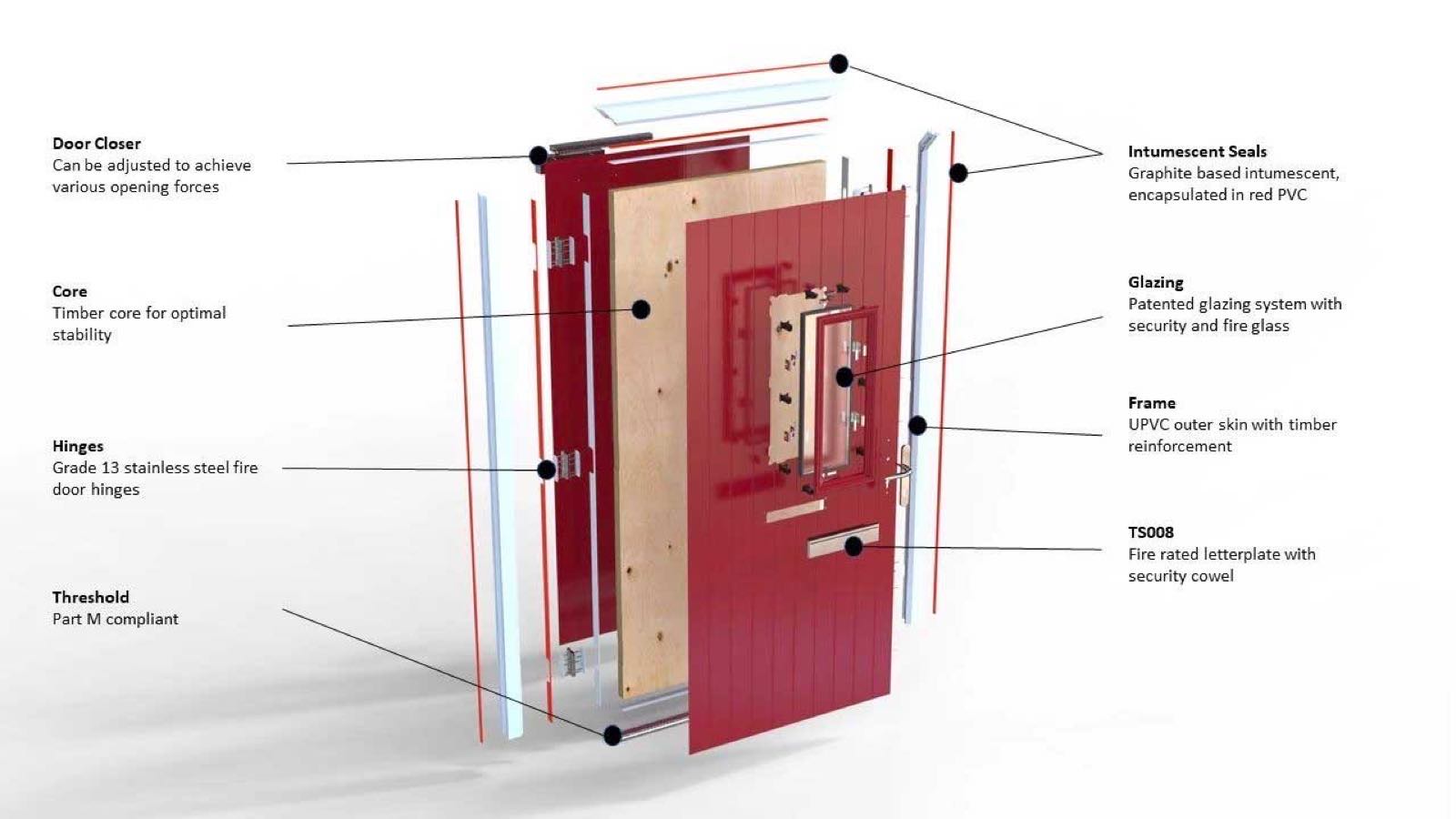
FD30 means the door assembly resists fire for 30 minutes when tested to BS 476-22 or BS EN 1634-1. The crucial word is assembly: the rating belongs to the door leaf, frame, hinges, seals and glazing working together, not to the leaf alone.
A genuine FD30 leaf is typically 44mm thick with a solid core, against 35mm for a standard internal door, and carries a certification label or colour-coded plug on its top edge. Licensing officers look for that label, so never paint over or remove it.
The ironmongery matters as much as the leaf. FD30 doors hang on three fire-rated hinges, and any glazing must be fire-rated glass, properly bedded in an intumescent glazing system; ordinary float glass in a fire door voids the whole assembly. Holes drilled through the leaf for cables or extra bolts compromise it too.
The simplest route to compliance is a certified doorset, where leaf and frame arrive as a tested pair. It costs more than a leaf alone, but it removes every argument about whether the assembly performs, which is exactly what you want when the licensing inspection comes round.
Intumescent strips and cold smoke seals
Two unobtrusive components do much of a fire door's work, and their absence is the most common defect we find on pre-licensing surveys.
Intumescent strips sit in a groove in the door edge or frame. At around 200 degrees they expand to many times their original size, sealing the gap between door and frame so fire cannot wrap around the leaf. Without them, a 44mm solid door fails in a fraction of its rated time.
Cold smoke seals, the brush or rubber fin running alongside the strip, do the opposite job: they block smoke in the early stages of a fire, before there is enough heat to activate the intumescent material. Smoke kills more people than flames, and it travels ahead of them, which is why HMO escape route doors are specified as fire and smoke doors rather than fire doors alone.
Combined strip-and-seal products cost £15–£30 per door in materials and are routed into existing solid doors easily, around £40–£80 per door fitted. They must run continuously along the top and both sides, and a brush seal clogged with paint no longer works, so decorators need warning before they cut in around the frames.
Self-closers: every escape route door needs one
An open fire door is just a doorway, so HMO doors onto escape routes must be self-closing. The standard solution is an overhead controlled closer, which must shut the door fully into its rebate and engage the latch from any opening angle, including a gentle release from 75mm open. A closer that slams or one that stalls short of the frame both fail inspection.
Concealed chain closers fitted into the door edge are sometimes accepted on bedroom doors because they look tidier, but practice varies between boroughs, so confirm with the licensing officer before specifying them across a whole property.
The biggest real-world failure is not the hardware but the tenants: wedged-open fire doors appear in almost every HMO we survey. Lecturing tenants rarely works, so where a door genuinely inconveniences people, consider free-swing or hold-open devices that let the door behave normally day to day and release it to close when the alarm sounds. They cost more, but a fire door that is actually closed at 3am is the only kind that works.
Budget £60–£120 per door for a quality closer supplied and fitted, and check every closer still closes the door fully at each inspection visit.
Upgrade existing doors or replace them?
Not every door in an HMO needs ripping out, and licensing officers generally accept properly executed upgrades, so the first job is to sort your doors into three groups.
Hollow-core doors, the lightweight flush doors fitted to millions of homes since the 1960s, can never be upgraded. There is nothing inside them to resist fire, so they are replaced with FD30 doorsets, £400–£900 each fitted.
Solid timber doors of substantial construction, close to 44mm thick, sound and well-fitted in solid frames, can usually be upgraded: intumescent strips and smoke seals, a self-closer, attention to gaps and hinges, and where panels are thin, an intumescent treatment or facing to bring them up to standard. Expect £150–£350 per door.
Period panelled doors deserve special mention because original Victorian doors are often worth keeping, and a sympathetic upgrade preserves both the character and the value of the house. A surveyor measures thickness, panel depth, condition and fit before recommending either route.
The honest rule: upgrade where the door is genuinely substantial, replace where it is not, and never pay anyone to upgrade a hollow-core door, because the result fails the first proper inspection.
Gap tolerances and what licensing officers check
Fire doors fail inspections on millimetres. The gap between the door leaf and the frame should be around 3mm at the head and both sides, and never more than 4mm; beyond that, intumescent strips cannot reliably close the gap and the door is recorded as defective. At the threshold, up to 8mm to the floor covering is generally acceptable, less where the risk assessment requires cold smoke sealing at the bottom, in which case a drop-down seal solves it.
Officers carry gap gauges and work through a consistent list. They check the certification label on the top edge, the gaps all round, that strips and seals are continuous and not painted solid, that the closer shuts the door fully from a short distance, that all three hinges are present with every screw fitted, that any glazing is fire-rated, and that the frame itself is solid and properly fixed.
They also look for the damage that accumulates in shared houses: kicked panels, missing latches and doors planed down so far the seals no longer meet the frame.
A pre-licensing walk-round with a gap gauge and a screwdriver costs very little and routinely turns a failed inspection into a passed one.
Fire door costs for London HMOs in 2026
Fire door work prices best as a package. Each visit to an HMO carries fixed costs, parking, access arrangements and tenant coordination, so doing one door at a time is the most expensive possible way to reach compliance.
The table below shows 2026 London rates. A typical five-bedroom HMO needing a mix of new doorsets and upgrades lands at £2,500–£5,500 for the full set, including closers, seals and making good.
Two pieces of advice from the licensing jobs we handle. First, agree the schedule of doors with the council before ordering anything; officers will usually confirm by email which doors need full FD30 doorsets and which they will accept as upgrades, and that confirmation protects you from doing the work twice. Second, keep the paperwork: doorset certificates, photographs of the labels and an invoice describing the works door by door. We fit and upgrade fire doors across London HMOs and supplies that evidence pack as standard, because the inspection is only ever as smooth as the documentation behind it.
Fire door work
Typical London cost (2026)
Certified FD30 doorset, supplied and fitted
£400 – £900
Upgrade existing solid door (strips, seals, closer)
£150 – £350
Self-closer supplied and fitted
£60 – £120
Intumescent strip and smoke seal, per door
£40 – £80
Fire-rated glazing, per pane
£150 – £400
Typical 5-bed HMO full door package
£2,500 – £5,500
Frequently Asked Questions
Do all doors in an HMO need to be fire doors?
No, only doors opening onto the escape route: bedrooms, kitchens and living rooms onto halls, landings and staircases. Bathroom and WC doors are normally exempt because they contain little fire load, though cupboards housing meters or boilers on the escape route usually do need FD30 doors.
Can I upgrade existing doors instead of buying FD30 doorsets?
Often, yes. Solid, well-fitted doors close to 44mm thick can usually be upgraded with intumescent strips, smoke seals and a closer for £150–£350 per door. Hollow-core doors can never be upgraded and must be replaced with certified FD30 doorsets at £400–£900 fitted.
Do HMO fire doors need self-closers?
Yes. Fire doors on HMO escape routes must be self-closing, and the closer must shut the door fully into its rebate from any angle. Overhead closers cost £60–£120 fitted; free-swing devices that release on the alarm are worth considering where tenants habitually wedge doors open.
What is the maximum gap allowed around a fire door?
Aim for 3mm between the leaf and frame at the head and both sides, and never more than 4mm, or the intumescent strips cannot seal the gap. At the threshold, up to 8mm to the floor covering is generally accepted unless the risk assessment requires a smoke seal at the bottom.
How much does it cost to make a 5-bed HMO's doors compliant?
Budget £2,500–£5,500 in 2026 for a typical five-bedroom London HMO, covering a mix of new FD30 doorsets at £400–£900, upgrades to sound existing doors at £150–£350, closers, seals and making good, all done in one mobilisation.